 DataCareph
Top 6 LLMs by Real-World Usage — Why Market Reach Defines AI’s Business Value
Here’s the summary of this article content.
Top 6 LLMs by Real-World Usage — Why Market Reach Defines AI’s Business Value
Introduction
Large language models (LLMs) are no longer experimental technologies; they are market-shaping platforms with billions of users worldwide. The ability of an LLM to scale and retain active users now serves as a proxy for its real-world value and competitive strength. According to DataCareph workflow and research automation, the latest insights show clear differentiation in adoption across the six most widely deployed models.
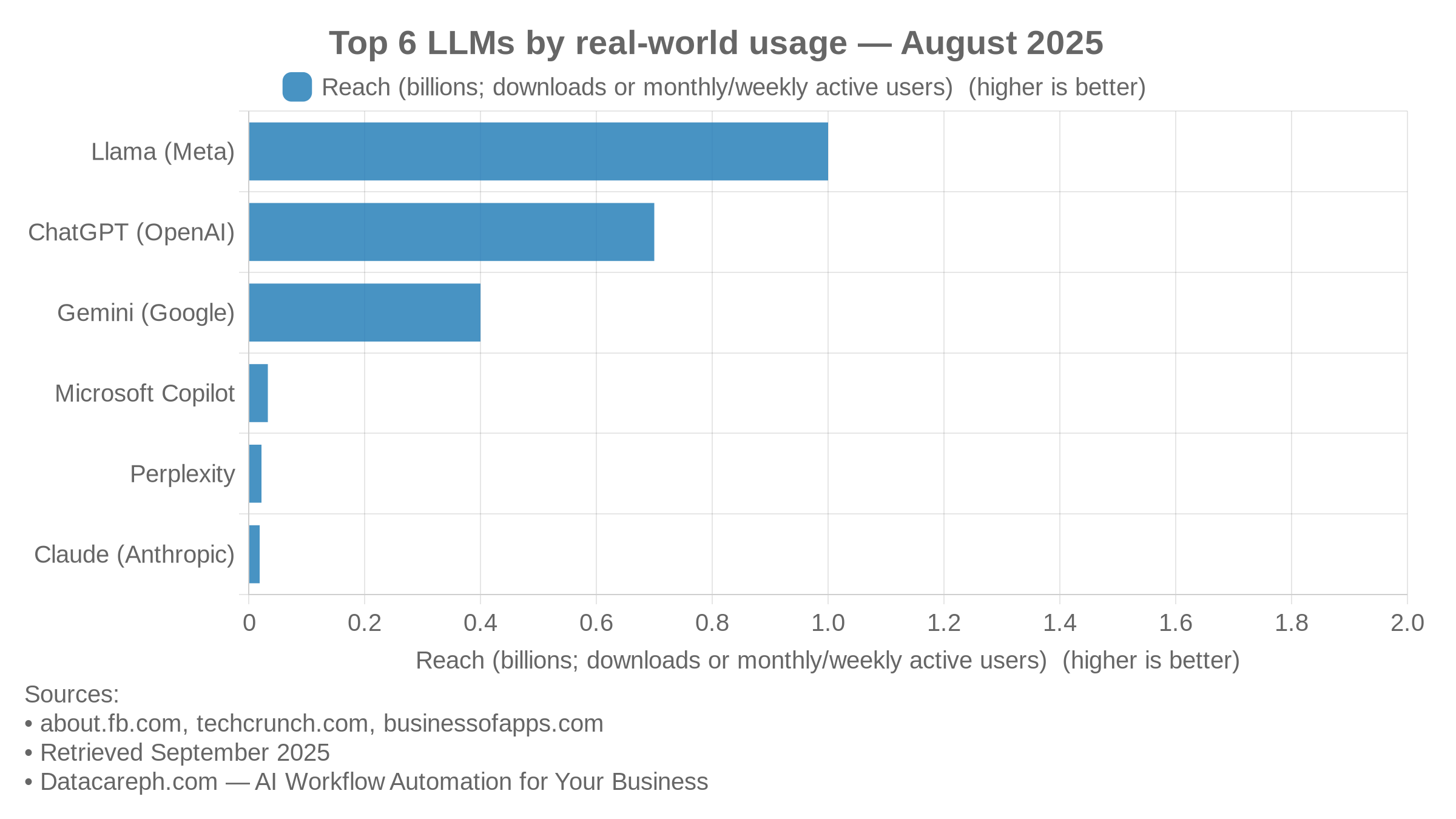
The research, captured under the chart “Top 6 LLMs by real-world usage — August 2025”, evaluates adoption through the lens of reach (billions; downloads or monthly/weekly active users) — with higher values signifying greater market penetration.
Why It Matters
The business significance of LLM adoption lies in three key areas:
Benefits
Network effects: The larger the user base, the faster the feedback loops and fine-tuning cycles.
Ecosystem integration: Models with high reach attract developers, enterprises, and third-party tools.
Market confidence: Adoption levels signal commercial viability to investors and enterprise buyers.
Challenges
Saturation risks: High adoption may mask retention issues if models struggle to sustain engagement.
Infrastructure costs: Models at scale face heavy operational expenses, from GPU clusters to energy draw.
Regulatory exposure: Leading platforms face scrutiny in areas such as privacy, bias, and market dominance.
Strategic significance
For executives and researchers, understanding which LLMs are genuinely being used — not just hyped — informs investment, partnership, and integration decisions.
Methods — How the Research Was Automated and Collected
The data was gathered using DataCareph workflow automation and AI-assisted research pipelines. The process included:
Source selection — Only authoritative, verifiable reports were integrated, such as Meta’s official announcement of 1 billion downloads of Llama (Meta, 2025) and OpenAI’s reported trajectory of 700 million weekly users for ChatGPT (TechCrunch, 2025).
Automated extraction — Scripts pulled structured data points (user counts, download milestones, activity rates) from each source.
Normalization — All figures were standardized into a comparable metric: reach in billions of active users or downloads.
Cross-verification — External datasets, such as Business of Apps, were layered to validate Copilot usage and revenue correlations.
This automation ensured consistency and minimized manual bias, enabling rapid updates as market conditions evolve.
Comparative Results — Leaders and Laggards
The analysis ranks the models as follows (values represent billions of reach):
Llama (Meta) — 1.0
Meta’s Llama dominates with 1 billion downloads, leveraging Facebook, Instagram, and WhatsApp ecosystems to scale rapidly.ChatGPT (OpenAI) — 0.7
With 700 million weekly users, ChatGPT remains a consumer and enterprise staple, particularly in education, content creation, and productivity software.Gemini (Google) — 0.4
Despite Google’s vast ecosystem, Gemini lags behind, though its tight integration into Search and Workspace products signals steady growth.Microsoft Copilot — 0.033
With only 33 million active users, Copilot’s adoption is modest relative to Microsoft’s enterprise footprint, but its revenue-per-user potential is higher given its professional user base.Perplexity — 0.022
As a smaller player with 22 million users, Perplexity carves out a niche with real-time search-driven responses, though scalability remains uncertain.Claude (Anthropic) — 0.0189
With 18.9 million users, Claude shows promise in specialized contexts (safety-first enterprises, compliance-heavy industries), but lacks mainstream adoption.
Common Mistakes / Pitfalls in Interpreting LLM Usage
Confusing downloads with active use: Meta’s Llama boasts high downloads, but active engagement metrics remain less transparent.
Overlooking enterprise concentration: Microsoft Copilot may trail in users but holds high-value corporate adoption.
Ignoring regional variance: Usage distribution is uneven — with Western markets driving ChatGPT and Asia showing stronger adoption of Meta-backed Llama.
Equating hype with usage: Smaller players like Claude often benefit from media attention that overstates their actual reach.
Conclusion
The Top 6 LLMs by real-world usage — August 2025 reveal a landscape where Meta and OpenAI lead, Google maintains a secondary foothold, and Microsoft, Anthropic, and Perplexity compete in specialized niches.
For businesses, the practical takeaway is clear:
If scale matters (consumer apps, mass-market tools) — Meta’s Llama and OpenAI’s ChatGPT are safest bets.
If enterprise integration and ROI matter — Microsoft Copilot holds unique value despite smaller reach.
If differentiation and compliance matter — Claude offers a focused, safety-conscious alternative.
As AI adoption accelerates, leaders must align LLM choice with strategic goals — whether reach, integration, or specialization. DataCareph’s research automation ensures decision-makers can trust that their strategies are based on accurate, real-world usage data rather than hype.
References / Additional Resources
TechCrunch — OpenAI says ChatGPT is on track to reach 700M weekly users
Business of Apps — Microsoft Copilot Revenue and Usage Statistics (2025)
OECD — AI Policy Observatory
Stanford HAI — AI Index Report
MIT Sloan Management Review — AI and Business Strategy