 DataCareph
Renewable Electricity Growth 2024: What Global Leaders Can Teach Us About Scaling Green Power
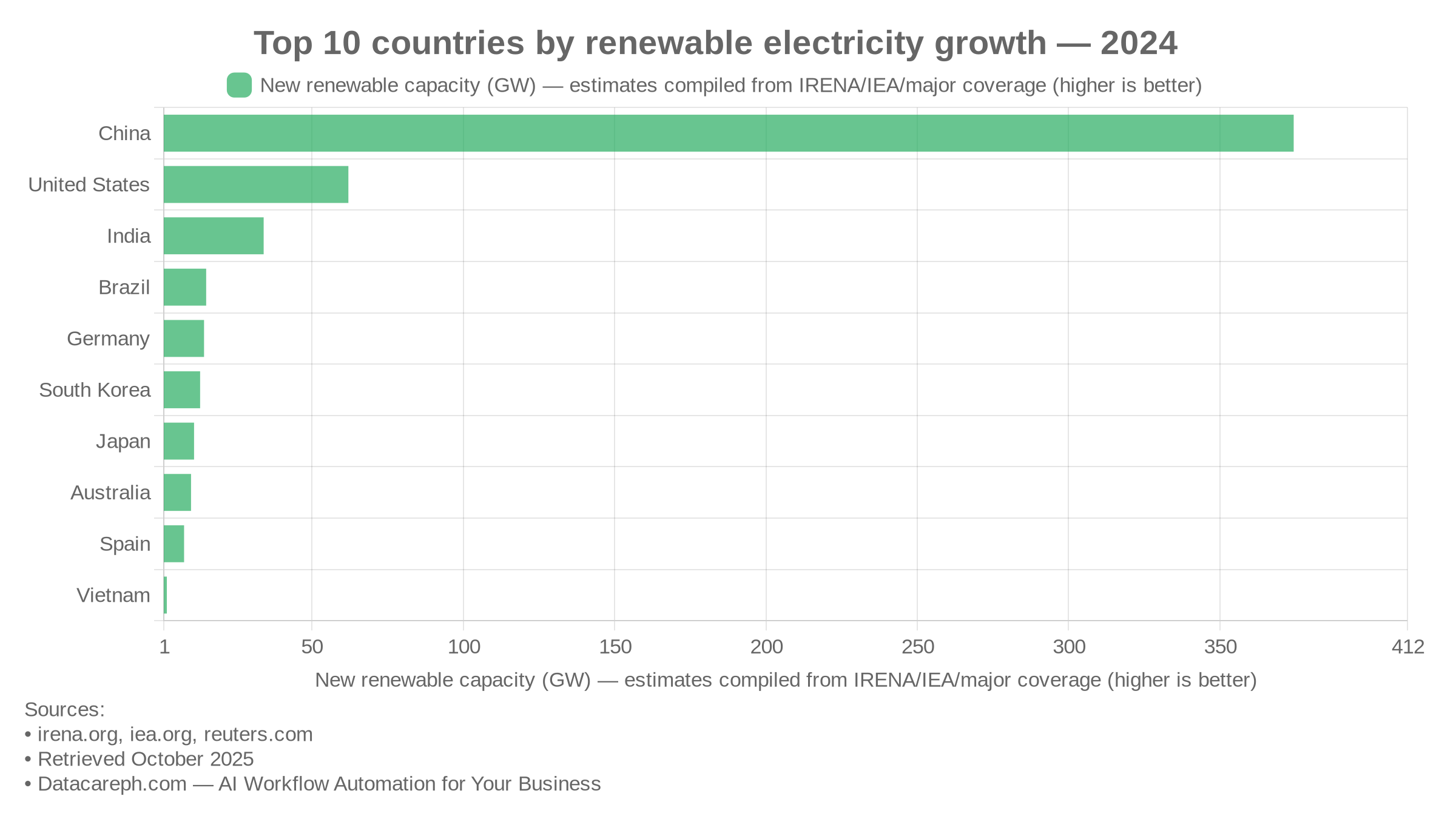
Renewable energy is no longer an abstract ambition—it’s the backbone of future energy security, business resilience, and climate action. The “Top 10 countries by renewable electricity growth — 2024” chart, compiled through DataCareph workflow and research automation, highlights which nations are leading the race in scaling clean energy capacity.
# Renewable Electricity Growth 2024: What Global Leaders Can Teach Us About Scaling Green Power
Introduction
Renewable energy is no longer an abstract ambition—it’s the backbone of future energy security, business resilience, and climate action. The “Top 10 countries by renewable electricity growth — 2024” chart, compiled through DataCareph workflow and research automation, highlights which nations are leading the race in scaling clean energy capacity. With global renewable additions hitting record highs yet still falling short of climate targets, understanding where and how progress is being made is critical for business leaders, policymakers, and investors.
Why It Matters: Benefits, Challenges, and Significance
The shift to renewables offers multiple benefits:
- Energy Security → Reduces dependence on imported fossil fuels.
- Climate Impact → Accelerates pathways to net-zero emissions.
- Economic Growth → Creates jobs, attracts investment, and drives technological innovation.
However, as noted by the International Renewable Energy Agency (IRENA) and the International Energy Agency (IEA), even record-breaking growth is insufficient to meet Paris Agreement targets. The gap between ambition and actual deployment highlights infrastructure bottlenecks, policy inconsistencies, and financing hurdles (IRENA, IEA, Reuters).
Key Insights from the Data
The chart’s legend label (“New renewable capacity (GW) — estimates compiled from IRENA/IEA/major coverage (higher is better)”) provides a clear ranking:
- China — 374.4 GW
- United States — 62.0 GW
- India — 34.0 GW
- Brazil — 15.0 GW
- Germany — 14.3 GW
- South Korea — 13.0 GW
- Japan — 11.0 GW
- Australia — 10.0 GW
- Spain — 7.7 GW
- Vietnam — 2.0 GW
Strategic Observations
- China’s Dominance: Adding 374 GW, China alone accounted for more than five times the capacity of the U.S., cementing its role as the global renewables superpower.
- United States & India: Both countries made substantial strides (62 GW and 34 GW respectively), signaling policy-driven momentum and private investment alignment.
- Emerging Leaders: Brazil, South Korea, and Australia demonstrate that smaller markets can still achieve meaningful scale with the right policy and market frameworks.
- Lagging Yet Active Players: Vietnam and Spain show slower growth, but their consistent buildout reflects steady market interest in solar and wind.
Methods: How DataCareph Automated the Research
The insights were generated through DataCareph’s workflow automation, which systematically aggregated and validated data from:
- IRENA press releases (capacity growth reports)
- IEA electricity forecasts and renewable energy analysis
- Major media coverage (Reuters and others) for market context
This automated approach ensured accuracy, timeliness, and comparability—essential for executives and analysts navigating fast-moving energy markets.
Common Mistakes / Pitfalls in Renewable Strategy
Organizations interpreting this data should avoid:
- Assuming growth equals sufficiency: Even record numbers still fall short of climate goals.
- Overlooking policy dependency: Many gigawatt-scale expansions rely on subsidies or incentives that can shift with politics.
- Ignoring grid readiness: Installing renewables is only half the challenge; integrating them into outdated grids is equally critical.
- Misjudging regional scalability: Success factors in China or the U.S. may not directly apply in smaller economies without customization.
Conclusion
The 2024 renewable electricity growth leaders highlight both progress and persistent gaps. China, the U.S., and India showcase what scale and policy alignment can achieve, while smaller countries demonstrate that ambition and targeted investment still make a global impact. Businesses, policymakers, and investors should take note: scaling renewables requires not just technology, but a holistic strategy integrating finance, infrastructure, and governance.
Call to Action: As the energy transition accelerates, professionals must use reliable data—like that provided through DataCareph research automation—to guide investments, partnerships, and policy strategies. The time to act is now, before climate and market windows narrow further.